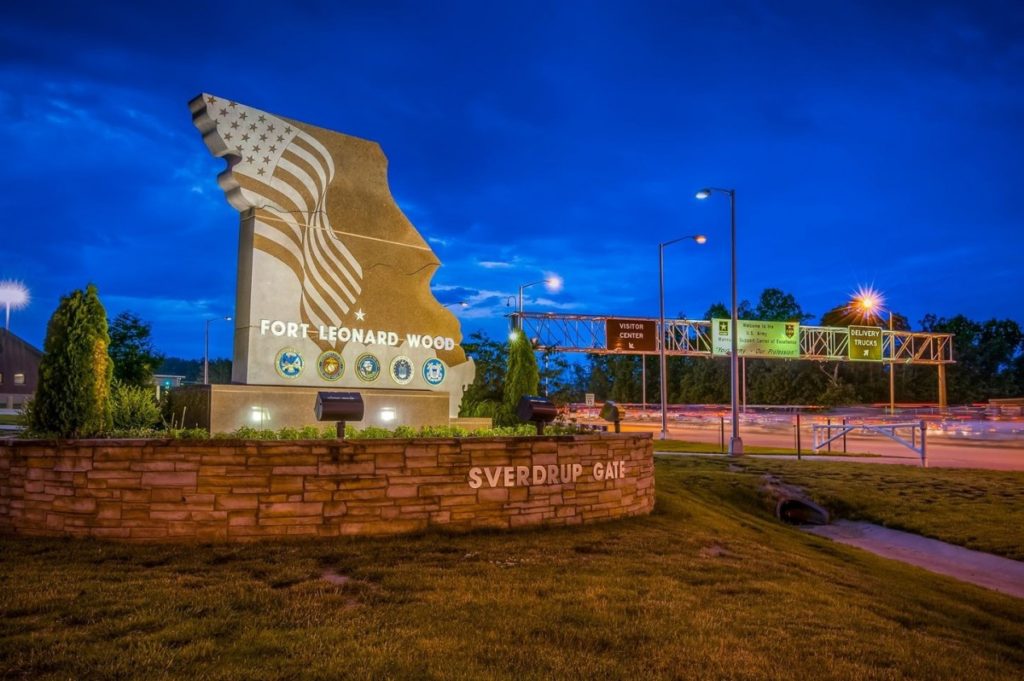
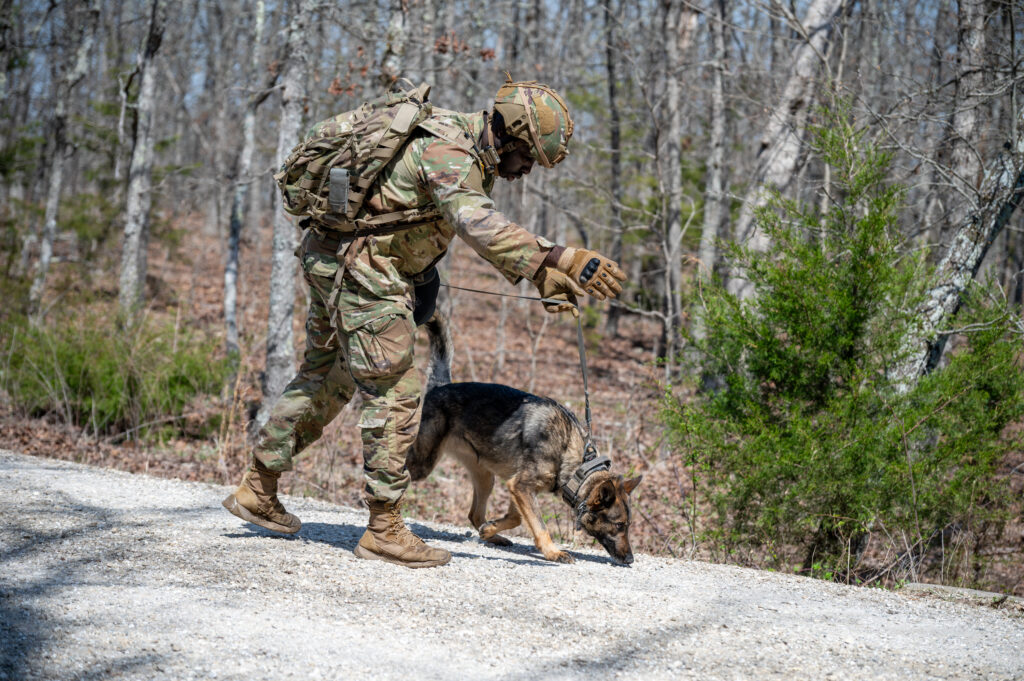
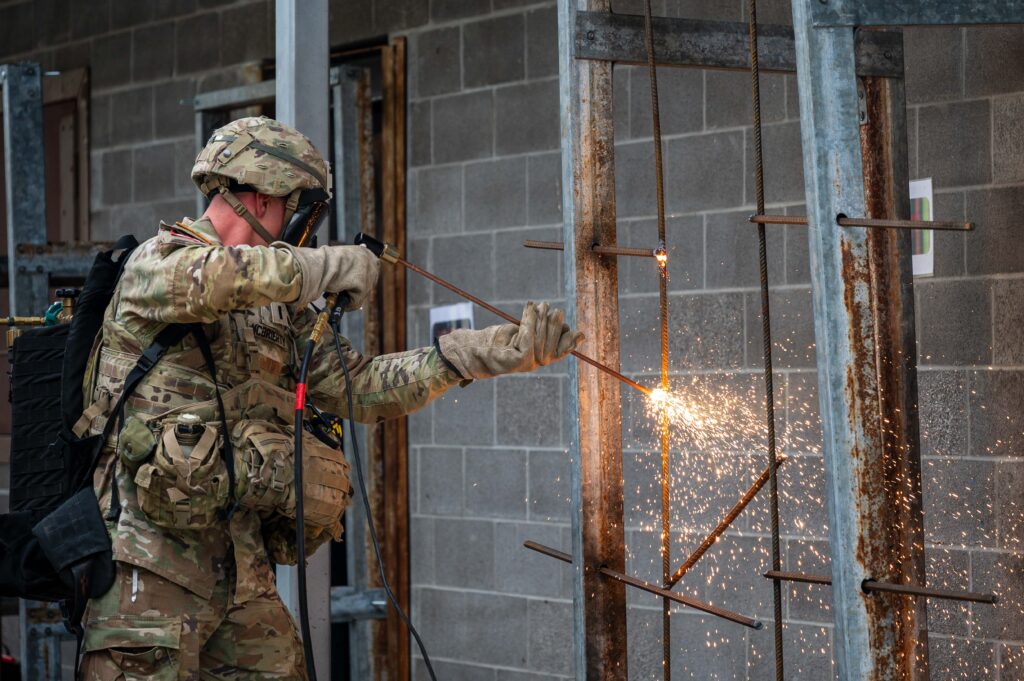
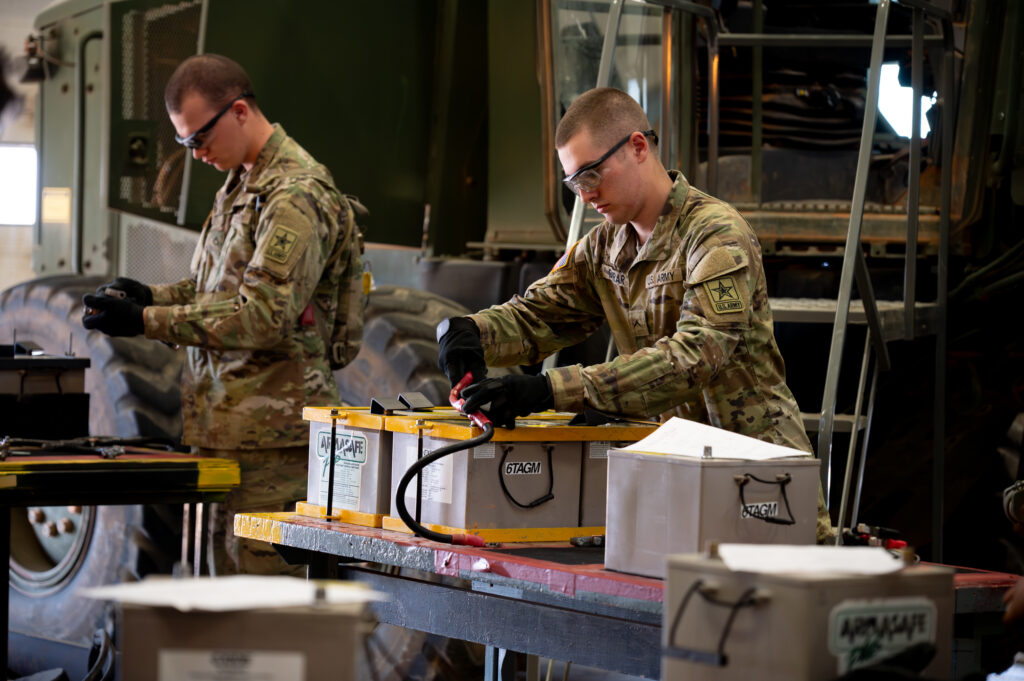
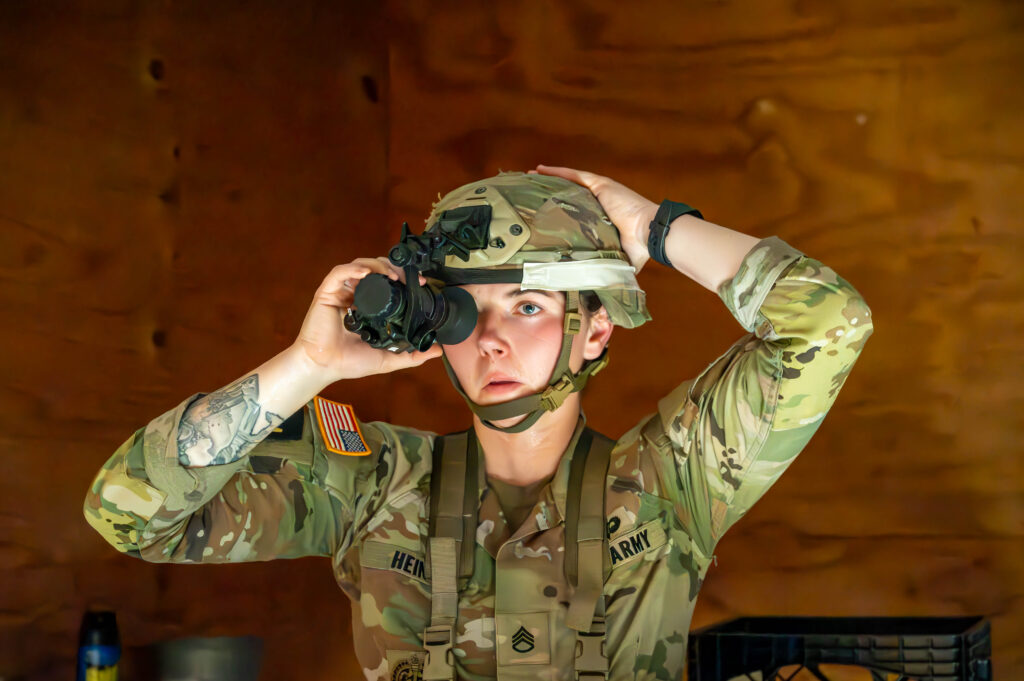
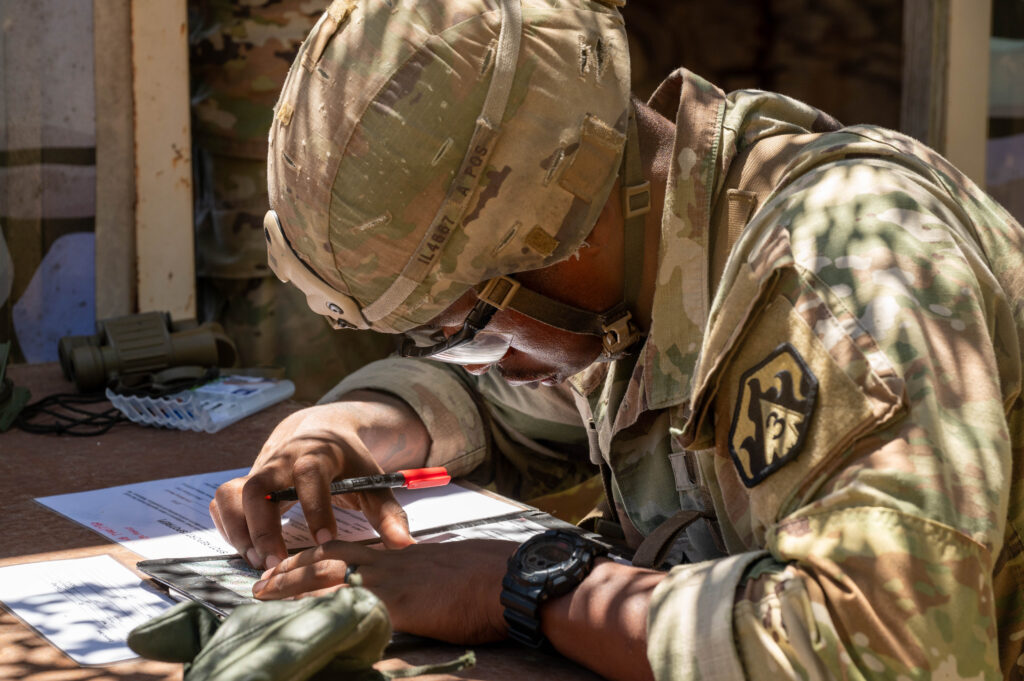
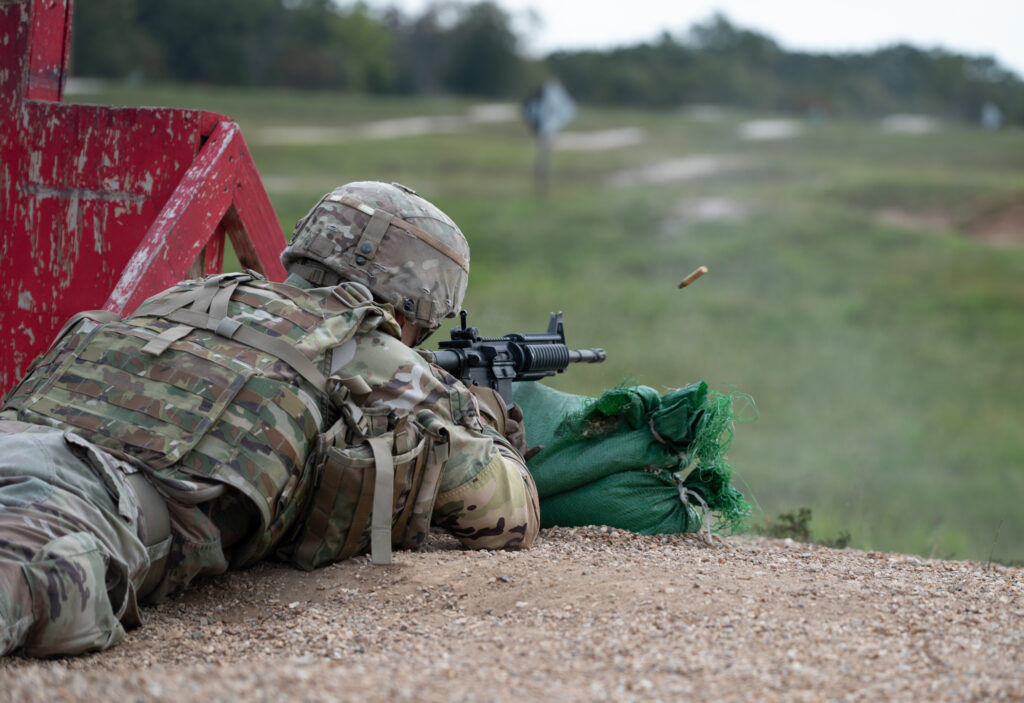
FORT LEONARD WOOD, Mo. (April 4, 2023) — Prepare for the boom! Soldiers at Fort Leonard Wood are scheduled to demonstrate the Linear Demolition Charge System launching a live Mine Clearing Line Charge between 9:30 and 10 a.m. today during the Combat Engineer Heavy Track Course. The exercise is expected to create a much louder boom than normal. Thank you for your patience as we give combat engineer students the chance to see and experience the effects of the blast.
Press Releases
AAFES honors Vietnam War-era veterans with pinning ceremony at Main Exchange
FORT LEONARD WOOD, Mo. (March 31, 2023) — Vietnam War-era veterans were honored by Army and Air Force Exchange Service employees, along with members of the Veterans of Foreign Wars Post 3176, on Wednesday at the Main Exchange, in recognition of Vietnam War Veterans Day. This year marks 50 years since the U.S. military ended its combat operations in Vietnam, on March 29, 1973.
As commemorative pins were given to all veterans who served during what’s often called the Vietnam War era — Nov. 1, 1955, to May 15, 1975 — Main Exchange Store Manager Stacy Firemoon-Saulsberry said it’s a pleasure to do this each year.
“It’s important for us to recognize our Vietnam vets,” she said. “The sacrifices they made for our nation — the least we can do is give back with a pin and presidential proclamation.”
Retired Command Sgt. Maj. James Breckenridge, who served as the Maneuver Support Center of Excellence and Fort Leonard Wood command sergeant major from 2018 to 2020, and is now the VFW Post 3176 junior vice commander, was on hand to support the event. He said it’s imperative Americans remember that Vietnam veterans didn’t get a welcome home when they initially returned from overseas.
“I really love that the (Main Exchange) does this, because we can never, ever stop thanking our Vietnam veterans for what they did and we should never stop,” Breckenridge said.
One of the veterans receiving a pin was Jackie Thomas, who served as an Army Combat Engineer and received a Purple Heart during his time in Vietnam. Thomas said veteran recognition has come a long way since the 1970s.
“This is an excellent program and I’m glad to be a part of it,” he said. “Coming back from Vietnam, I was kind of dishonored, because I didn’t get the welcome home thing. We went and did the job and came back — and some of us came back all broken up. I was fortunate that I was not. I did get a Purple Heart over there, but I was still mobile; I could still get around.”
Thomas said he meets a lot of veterans who simply want their family to be taken care of financially, and he highlighted a program designed to allow spouses to collect their veteran’s 100-percent disability pay, even after the veteran passes away.
“That is a good program,” he said. “That’s the way it’s supposed to be.”
Another veteran at the ceremony was Jim Ashby, who served in the Air Force during the Vietnam War. He said events like this make him feel appreciated, but that every veteran — and their families — should be recognized for their service.
“I think the (spouses) of the military members need to be recognized also, because they take care of the home, the children and they worry about us,” he said.
Firemoon-Saulsberry said any Vietnam War-era veteran who was unable to attend the ceremony is welcome to visit the Main Exchange customer service desk, where additional pins and copies of the presidential proclamation will be kept for the remainder of the week.
More photos from the pin presentations here are available on the Fort Leonard Wood Flickr page.
(Editor’s note: Angi Betran, Fort Leonard Wood Public Affairs Office, contributed to this article.)

-30-
About Fort Leonard Wood
Fort Leonard Wood is a thriving and prosperous installation that has evolved from a small basic training post more than 80 years ago to a premier Army Center of Excellence that trains nearly 80,000 military and civilians each year.
Fort Leonard Wood is home to the U.S Army Maneuver Support Center of Excellence and three U.S. Army schools: the U.S. Army Engineer School; U.S. Army Chemical, Biological, Radiological and Nuclear School; and the U.S. Army Military Police School. In addition to training engineer, CBRN and military police specialties for the Army, Fort Leonard Wood also provides gender-integrated in-processing and Basic Combat Training for new Soldiers.
Fort Leonard Wood also hosts and trains with the largest Marine Corps Detachment and Air Force Squadron on any Army installation as well as a large Navy construction detachment.
More information about Fort Leonard Wood is at: https://home.army.mil/wood/index.php/about/mission
Finishing what he started: 50-year-old Alabama police officer returns to Army service after 17-year break
By Brian Hill, Fort Leonard Wood Public Affairs Office
FORT LEONARD WOOD, Mo. (March 30, 2023) — Staff Sgt. Randall Threet stood out among the basic combat training graduates from Company F, 1st Battalion, 48th Infantry Regiment, who walked across the Baker Theater stage today.
For one thing, he’s an NCO completing BCT alongside about 300 privates and privates first class. For another, he’s as old or older than most of his fellow trainees’ parents.
“They don’t see me as a father figure — more like a grandfather figure,” Threet said with a laugh. “One of the guys came up to me one day to show me some pictures. He said, ‘Look, this is my grandfather. He’s only a year older than you.’”
This is Threet’s second BCT experience. He first completed initial military training 30 years ago in 1993, at Fort McClellan, Alabama, entering the Army Reserve as a Military Policeman.
“I’d always wanted to be a police officer, and I figured the best way to get some experience would be the military,” he said. “My grandfather was in the military also, back in World War II, and he was an MP, so I figured that would be the way to go — I looked up to my grandfather and wanted to follow in his footsteps.”
Threet did become a police officer, in his hometown of Athens, Alabama, and he’s been doing that for the past 23 years. He said he enjoys being able to help people.
“You basically get to help the people in your community, the people you actually live with — so basically, you’re helping your neighbors,” he said.
One regret he has had, though, was transitioning out of the Army in 2006 — going through this experience now is a way to finish what he started, he said.
“I initially joined with the idea that I was going to do my complete 20 years,” Threet said. “After getting out, I realized I had made a mistake. So, I got back in to finish what I had started.”
Getting to this point was the hardest part, he added, noting he started the process about 2.5 years ago.
“A friend I had deployed with sent me an article on a gentleman who was 58 and had gotten back into the service,” Threet said. “I jokingly messaged him and said, ‘I’m in better shape now than I was. Do you think they would take me?’ He messaged me back and said ‘Try.’”
With his prior service documented, and an age waiver completed, Threet was back in, though he said there were moments when he wasn’t sure the Army would take him.
“There were a couple of times when I thought this isn’t going to happen — I guess I’m too old,” he said. “There was a lot of paperwork. The Army wants all the i’s dotted and t’s crossed.”
Going through BCT a second time — a requirement for someone who has been out of the military that long — Threet said some of the experience was more difficult, but he also feels good knowing he “hung in there with a bunch of 18-, 19-year-olds.”
“It really made me feel my age sometimes, but I figured, if I can do this, I think I can do anything,” he said.
One of Threet’s drill sergeants in Foxtrot Company, Staff Sgt. Nena Tulensru, said he’s only ever trained one other older trainee — a 48-year-old about a year ago.
“It’s challenging for them, but they push,” Tulensru said. “They’re the ones who hold the standard for the rest of the trainees to follow. They set the example.”
Pvt. Jesse Terrell trained alongside Threet. The 20-year-old, who will perform human resources functions for the Oklahoma National Guard, said it was inspiring having Threet in the unit.
“I definitely worked harder knowing he was here because I didn’t want to be outworked by him,” Terrell said. “I think it really helped us a lot as a unit to see someone his age doing so well, and if we had questions, he’s done his best to answer what he can.”
Threet said living with hundreds of younger trainees for 10 weeks has had its ups and downs — he looks forward to a Caribbean vacation with his wife now that it’s over — but he has seen the discipline and confidence instilled in them at BCT.
“They might decide the Army isn’t a good fit for them — and they may decide they want to do 20 years — but it’s good for them,” he said. “It gives them a different perspective on life and will help them in their future careers. Working with other people. Accomplishing a task. That’s a lot of what the Army teaches you, and that’s what most workplaces look for — someone who is a team player, who can get in there, work with a group and get the job done. To me, that’s what the Army is all about.”
To others like him out there on the fence about joining the Army, Threet said “don’t ever think you’re too old for something — get out there and do it.”
“Don’t underestimate the old guys,” he said.

-30-
About Fort Leonard Wood
Fort Leonard Wood is a thriving and prosperous installation that has evolved from a small basic training post more than 80 years ago to a premier Army Center of Excellence that trains nearly 80,000 military and civilians each year.
Fort Leonard Wood is home to the U.S Army Maneuver Support Center of Excellence and three U.S. Army schools: the U.S. Army Engineer School; U.S. Army Chemical, Biological, Radiological and Nuclear School; and the U.S. Army Military Police School. In addition to training engineer, CBRN and military police specialties for the Army, Fort Leonard Wood also provides gender-integrated in-processing and Basic Combat Training for new Soldiers.
Fort Leonard Wood also hosts and trains with the largest Marine Corps Detachment and Air Force Squadron on any Army installation as well as a large Navy construction detachment.
More information about Fort Leonard Wood is at: https://home.army.mil/wood/index.php/about/mission
Fort Leonard Wood leaders talk heat injury prevention at forum
By Brian Hill, Fort Leonard Wood Public Affairs Office
FORT LEONARD WOOD, Mo. (March 29, 2023) — With summer and warmer temperatures on the way here, Maneuver Support Center of Excellence training leaders came together on Monday in Lincoln Hall Auditorium to learn more about the prevention, mitigation, recognition and treatment of heat injuries.
Oscar Powers, MSCoE Safety director, noted heat injuries — including heat exhaustion, heat stroke and other related illnesses — have been on the decline here over the past couple of years, but that mid-Missouri still sees an average of 63 days throughout the summer that reach the high end of the Army’s heat categorization system.
“The purpose of this event is to review established policy and guidance for Fort Leonard Wood organizations for prevention, management and reporting (heat injuries),” Powers said.
Helping explain the prevention, identification and assessment of heat injuries were some of Fort Leonard Wood’s medical experts.
Lt. Col. Patrick Walsh, a brigade surgeon with the 3rd Chemical Brigade, explained some of the basics, including what’s called heat load, or the physiological strain on a person’s body as they attempt to compensate for the stress produced in the body by high environmental temperatures.
“When it’s hotter outside, that increases the load even more,” Walsh said, noting temperature, humidity and wind conditions affect the body and its ability to adjust to heat. “The key things that the body requires to keep a good balance between that physiological strain — so that heat load doesn’t get to be too much — is the appropriate amount of hydration, good nutrition and recovery time, sleep time. The body does the vast majority of its repair and recovery during the hours of sleep.”
Another consideration when it comes to the effects heat has on the body, Walsh said, is that “it builds upon itself.”
“So, they may have done just fine on day one, but they still took a certain amount of strain,” he said. “So now, on day two, they’re not going to be able to tolerate as much as they did on day one, and by day three, a large portion of your population are not going to be even close to being able to tolerate what they tolerated on day one. That’s something we have to consider when we’re taking a look at training schedules.”
The adverse impact of high environmental temperatures can be reduced by drinking enough water, getting proper nutrition, the type of clothing worn, maintaining a high level of fitness and resting after exposure to heat, Walsh said.
“The body’s primary systems for cooling itself are evaporation, radiation — you get some radiation from the skin — and then convection — so, is there a breeze, or is there not a breeze, and then how much of their body’s surface area is getting exposed to that moving air,” Walsh said.
The Army has an acronym — HEAT — to help when trying to prevent heat injuries, Walsh noted.
- High heat category, especially on several sequential days (measure the wet bulb globe temperature, or WBGT, index when the ambient temperature is higher than 75 degrees Fahrenheit).
- Exertional level of training, especially on several sequential days (the past 72 hours must be considered).
- Acclimatization — most individuals’ physiological responses to heat stress improve within 10 to 14 days of exposure to heat and regular strenuous exercise.
- Time (length of heat exposure and recovery time).
Walsh also discussed proper hydration measures. He said water should be consumed before a person gets thirsty and at regular intervals. However, there are dangers when it comes to the over-consumption of water, which can lead to a medical emergency called hyponatremia.
“Soldiers shouldn’t be taking in more than about a quart and a half of fluid per hour on the average,” Walsh said.
In addition to water, Walsh said individuals should ensure they are eating enough to stay hydrated, as food can be an additional source of fluids, and contains electrolytes and carbohydrates necessary to maintain hydration. Males should be consuming a minimum of 1,700 calories per day; females should intake at least 1,450 calories per day — however, Walsh noted each person’s needs will be slightly different.
Maj. Nicholas Kohles, brigade surgeon for the 14th Military Police Brigade, spoke on developing controls for heat injuries, including the Army’s Arm Immersion Cooling System, or AICS.
Extremity immersion in cold water is an effective cooling method, Kohles said. He recommended three to five minutes of arm immersion in water cooled to one degree Celsius — or about 33 to 34 degrees Fahrenheit.
Kohles also explained some of the differences between heat exhaustion and heat stroke, and he provided some of the symptoms cadre should look for.
Heat exhaustion is caused by the loss of body fluids through sweating, vomiting or diarrhea without adequate fluid replacement. Anyone performing physical exertion in hot environments is susceptible, Kohles said.
“People very physically fit can get this,” he added.
Symptoms include excessive sweating with pale, moist, cool skin; headache or dizziness; cramps; loss of appetite; and nausea (with or without vomiting).
First aid for heat exhaustion includes loosening the uniform and removing head gear; placing the individual in a shady area; and having them drink no more than 1 to 1.5 quarts of water per hour. The individual should be constantly monitored and evacuated for medical treatment if symptoms worsen or do not improve after rest and rehydration.
Heat stroke is caused by exposure to high temperatures and a rise in body temperature, with a failure in the body’s cooling mechanisms, Kohles said.
Symptoms include confusion, weakness, dizziness, headache, seizures, nausea, stomach cramps or pain, red or hot skin, and rapid and weak respiration and pulse. Unconsciousness and collapse may occur suddenly.
“A Soldier with a heat stroke may also stop sweating,” Kohles said.
First aid for heat stroke includes fully removing the individual’s outer clothing and using ice sheets to attempt to rapidly cool the individual. Cadre should report a suspected heat stroke victim to range control and evacuate them immediately to the nearest emergency room via ambulance, while maintaining cooling techniques and constant monitoring of their mental status — ask questions, such as their name, where they are or what year it is — level of consciousness, breathing and pulse.
After a briefing on General Leonard Wood Army Community Hospital’s care and return-to-duty procedures for heat injuries, battalion commanders were invited to explain some of their lessons learned and best practices with regards to heat injury prevention.
Involving trainees in their medical emergency drills improves the unit’s ability to quickly react if someone has a heat injury, said Lt. Col. Jarrad Glasenapp, 3rd Battalion, 10th Infantry Regiment commander.
“We integrate the trainees into those drills, where they know immediately where the ice is, and they can bring those to the victim and support the drill sergeants in those operations,” Glasenapp said.
Heat injury prevention for the trainees is discussed a lot, Glasenapp noted, but there also needs to be a focus on the cadre as well.
“We talk to them a lot about nutrition, the use of sunscreen, work-rest cycles, rotations of those drill sergeants out there — that’s a huge part of it,” he added.
In addition to the information provided in Lincoln Hall Auditorium, the event concluded with a “Soldier-down” demonstration on MSCoE Plaza by cadre from the 169th Engineer Battalion. In the demonstration, a Soldier collapsed, and two cadre members responded. After assessing the potential for a heat stroke, the Soldier was carried into the shade, his outer clothing was removed and ice sheets were applied in anticipation of medical evacuation to the nearest emergency room.
One of the forum’s attendees, 1st Battalion, 48th Infantry Regiment Command Sgt. Maj. Matthew Reed, said heat injury prevention training is “vitally important for our team.”
“While Fort Leonard Wood maintains significantly lower rates of heat injuries compared to other training installations, our teams change frequently as cadre and drill sergeants move in and out of position due to (permanent change of station) moves,” Reed said.
Establishing baseline knowledge and proliferating best practices are essential components to learning organizations, “such as ours,” he said.
“I believe one of the reasons we do so well here at Fort Leonard Wood is because we place a high emphasis on coupling hard training with protocols that ensure the safety of our Soldiers,” Reed said. “You don’t have to sacrifice one for the other — battalions can do both, so long as risk is appropriately assessed and mitigated.”
Reed said he found the battalions’ best practices portion of the event particularly useful, specifically how Glasenapp’s unit incorporates trainees into their heat injury response exercises.
“That’s a good technique that ensures both cadre and trainees understand how to prevent, identify and treat hot-weather injuries,” Reed said. “We intend to integrate it in our battalion.”
More information on preventing heat injuries is available on the Defense Centers for Public Health website.

-30-
About Fort Leonard Wood
Fort Leonard Wood is a thriving and prosperous installation that has evolved from a small basic training post more than 80 years ago to a premier Army Center of Excellence that trains nearly 80,000 military and civilians each year.
Fort Leonard Wood is home to the U.S Army Maneuver Support Center of Excellence and three U.S. Army schools: the U.S. Army Engineer School; U.S. Army Chemical, Biological, Radiological and Nuclear School; and the U.S. Army Military Police School. In addition to training engineer, CBRN and military police specialties for the Army, Fort Leonard Wood also provides gender-integrated in-processing and Basic Combat Training for new Soldiers.
Fort Leonard Wood also hosts and trains with the largest Marine Corps Detachment and Air Force Squadron on any Army installation as well as a large Navy construction detachment.
More information about Fort Leonard Wood is at: https://home.army.mil/wood/index.php/about/mission
Garrison leaders introduce community mayors at quarterly housing town hall
By Melissa Buckley, Fort Leonard Wood Public Affairs Office
FORT LEONARD WOOD, Mo. (March 28, 2023) — Fort Leonard Wood’s newly elected community mayors were introduced Tuesday at the quarterly housing town hall, hosted by U.S. Army Garrison Fort Leonard Wood leaders.
Col. Anthony Pollio, U.S. Army Garrison Fort Leonard Wood commander, recognized last year’s outgoing mayors, then announced the incoming ones. This year’s neighborhood representatives are Sarah Saalman for Eagle Point, Brian Wimer for Woodlands, Eric Hawes for North Stonegate, Howie Paulino for South Leiber Heights, Angela Chrisman for Piney Hills and Brian Bolton for Piney Estates.
Sgt. 1st Class Brian Wimer, the 35th Engineer Battalion NCO in charge of operations, said he wanted to run for mayor to make it easier for his community members to reach out for help.
“We live far away from our families. My family is back home in Wisconsin. Our neighbors here become our family,” Wimer said. “I want to be there for them when they need help with a work order or need a point of contact for an issue.”
Pollio also announced Fort Leonard Wood’s housing partner, Balfour Beatty Communities, is hiring four new staff members.
“We asked the Balfour Beatty team to hire new staff to help out with customer service, quality control and scheduling work orders,” Pollio said.
According to Jason Williams, BBC’s operations director here, two new employees are being added to the leasing office and two to the maintenance department.
“One of the first people we are hiring is a full-time receptionist. This way, we will get all of your phone calls and there will always be somebody at the front desk. Another position is a new leasing agent. Right now, we have 1,800 houses and only six leasing agents trying to manage that. With the additional leasing agent this will allow them to rotate, so that somebody is always in the office,” Williams said.
A service coordinator is being added to the maintenance department to help resolve work orders and a new maintenance technician will be hired to inspect homes before new residents see them, according to Williams.
Ron Hestness, BBC’s facility director, said a new landscaping company has been contracted and will start mowing in April.
“On April 17, they will start a four-day weekly mowing schedule,” Hestness said.
The town hall was opened up to resident questions, and recent water outages was brought up. Pollio said there is a good reason for them.
“Previously, the government managed their own utilities. The water system is now being managed by a contractor. American Water is upgrading the infrastructure and that is why there is a large amount of work on water mains and pipes,” Pollio said. “I think of it as a good thing, but it does create inconveniences. Emergency water outages can’t be helped. For the scheduled ones, you should have better predictability.”
A topic discussed in a previous mayors’ meeting dealt with traffic on post. According to Master Sgt. Edgar Arnall, with the Directorate of Emergency Services, a traffic study is going to be conducted. They will be looking at signage, traffic flow and crosswalks.
“We are going to look at the data to help us decide things like if intersections warrant a stop sign or yield sign,” Arnall said.
Besides the quarterly housing town halls, another way for residents to voice concerns and get information is the walking town halls. According to Pollio, now that the weather is warming up, they will start back up next month.
“We will walk through a different neighborhood each month. All you have to do is walk out your front door and talk to us,” Pollio said.

-30-
About Fort Leonard Wood
Fort Leonard Wood is a thriving and prosperous installation that has evolved from a small basic training post more than 80 years ago to a premier Army Center of Excellence that trains nearly 80,000 military and civilians each year.
Fort Leonard Wood is home to the U.S Army Maneuver Support Center of Excellence and three U.S. Army schools: the U.S. Army Engineer School; U.S. Army Chemical, Biological, Radiological and Nuclear School; and the U.S. Army Military Police School. In addition to training engineer, CBRN and military police specialties for the Army, Fort Leonard Wood also provides gender-integrated in-processing and Basic Combat Training for new Soldiers.
Fort Leonard Wood also hosts and trains with the largest Marine Corps Detachment and Air Force Squadron on any Army installation as well as a large Navy construction detachment.
More information about Fort Leonard Wood is at: https://home.army.mil/wood/index.php/about/mission
Have a fun, safe turkey hunting season
By Lt. Jason Ploss, Fort Leonard Wood Conservation Law Enforcement supervisor
FORT LEONARD WOOD, Mo. — (March 21, 2023) With spring turkey hunting season approaching fast, now is the time to read and understand the regulations.
Missouri’s youth turkey hunting season is April 1 and 2, and the regular spring turkey season is scheduled for April 17 through May 7.
Fort Leonard Wood Regulation 210-21 “Hunting and Fishing Regulation” is free and available electronically on the iSportsman website. Hunters should read and be familiar with the regulation to ensure they are aware of and comply with all installation hunting rules. Missouri Department of Conservation regulations must also be followed and may be found here. The MDC’s seasonal summary of regulations publication is also available for pickup at any permit vendor or by stopping by the Conservation Law Enforcement Office in Bldg. 1000.
State hunting permits may be purchased on post at the Outdoor Adventure Center, which is open from 9 a.m. to 5 p.m. Tuesday through Saturday in Bldg. 2290. The OAC staff can be reached by calling 573.596.4223. Permits can also be purchased electronically on the MDC website. In addition to a state hunting permit, hunters will need iSportsman permits, which can be purchased on the iSportsman website.
Hunters must have both Fort Leonard Wood and state-issued permits with them while afield/hunting. Electronic permits are allowed through the iSportsman webpage and Missouri hunting app, but lack of service on a mobile device does not absolve someone from the requirement to carry permits while afield.
Another requirement on-post hunters must follow is ensuring check-in and check-out of open areas using iSportsman. Check-in and check-out procedures must be completed on the same day access is desired. You may check-in to two areas at the same time as long as the areas share a border with each other and are both open for recreation. All recreators must also display their six-digit iSportsman permit number in the front windshield of their vehicle while they are afield. The permit number must be placed in a manner that it is easily viewable from the outside of the vehicle. Be sure to confirm check-in prior to going afield and confirm your check-out upon leaving the area.
Youth turkey season
The youth turkey season is open to hunters ages 6 to 15. Hunting hours for the youth turkey season are 30 minutes before sunrise to sunset. Hunters need a Missouri spring turkey hunting permit and appropriate Fort Leonard Wood permits, which will also allow them to participate in the regular spring season. Youth hunters are limited to one male turkey, or a turkey with a visible beard. Hunters who take a turkey during the youth season may not harvest a second bird until April 25. This is because the bird taken during the youth season counts as the first bird for the first week of the regular season.
Spring turkey season
Hours for Missouri’s regular spring turkey season are 30 minutes before sunrise until 1 p.m. each day. Hunters must have a Missouri spring turkey hunting permit and appropriate Fort Leonard Wood permits. Hunters are limited to harvesting two male turkeys or turkeys with visible beards. Hunters may only take one turkey during the first week of the season, April 17 through 23. Hunters may harvest a second or both turkeys during the second and third week of the season, however they may not be taken on the same day.
Allowed methods
Weapons and equipment allowed during both the youth turkey season and the regular spring season include:
- shotguns with shot not larger than No. 4;
- longbows, recurve bows or compound bows;
- hand-held string releasing devices, illuminated sights, scopes and quick point sights;
- crossbows; and
- atlatls.
Prohibited methods
Hunters may not use:
- shotguns capable of holding more than three shells in a magazine and chamber combined;
- shot larger than No. 4 (in use or in possession);
- any sighting device that casts a beam of light on the game;
- thermal imagery equipment or night vision equipment (in use or in possession);
- recorded calls (in use or in possession);
- dogs or live decoys; or
- bait, which includes grain or other feed placed or scattered so as to attract turkeys or other wildlife. Additionally, placing consumable products that would cause a concentration of wildlife is a violation of county wide Chronic Wasting Decease restrictions and undermines efforts being made to combat the spread of CWD.
Safety tips
Hunters have a responsibility and must use risk-management skills to ensure everyone is safe. Review the safety tips below as a starting point for hunting safety this season:
- If you are not hunting, try to steer clear of areas where hunters may be.
- Attend a hunter safety course, even if it is not required where you hunt.
- Hunt in pairs and have a first-aid kit available.
- Take a cell phone and let someone know where you will be and when you will return.
- Know how to properly handle your weapon and follow all safety rules.
- Make sure all equipment is in good working condition.
- Avoid wearing blue or red while afield during turkey seasons to reduce the potential of becoming a victim of a misidentified target.
- Know side effects of prescription drugs and never drink alcohol while hunting.
- Report observed violations of the law to a Conservation Law Enforcement Officer or Military Police.
- Be sure of your target. Never point a weapon at anything that has not been identified.

-30-
About Fort Leonard Wood
Fort Leonard Wood is a thriving and prosperous installation that has evolved from a small basic training post more than 80 years ago to a premier Army Center of Excellence that trains nearly 80,000 military and civilians each year.
Fort Leonard Wood is home to the U.S Army Maneuver Support Center of Excellence and three U.S. Army schools: the U.S. Army Engineer School; U.S. Army Chemical, Biological, Radiological and Nuclear School; and the U.S. Army Military Police School. In addition to training engineer, CBRN and military police specialties for the Army, Fort Leonard Wood also provides gender-integrated in-processing and Basic Combat Training for new Soldiers.
Fort Leonard Wood also hosts and trains with the largest Marine Corps Detachment and Air Force Squadron on any Army installation as well as a large Navy construction detachment.
More information about Fort Leonard Wood is at: https://home.army.mil/wood/index.php/about/mission


