

By Ryan Thompson, Fort Leonard Wood Public Affairs Office
FORT LEONARD WOOD, Mo. (May 7, 2026) – As temperatures steadily rise and people begin spending more time outdoors, the chance of encountering ticks increases.
According to the Missouri Department of Conservation, limiting exposure to ticks is important because these tiny parasites can carry diseases, such as Lyme disease, Rocky Mountain spotted fever, ehrlichiosis, Bourbon virus and Heartland virus.
“For the training population, permanent party and their dependents, Rocky Mountain spotted fever, other tick-borne illness and alpha-gal, is life altering,” said Oscar Powers, Maneuver Support Center of Excellence safety director. “A mosquito bite and chiggers may itch, but tick-borne illness can have significant health repercussions.”
Alpha-gal syndrome can cause a serious allergic reaction to eating beef, pork, lamb or dairy, Powers explained.
Common ticks in Missouri include the lone star tick, American dog tick and the blacklegged tick. These three ticks are of particular concern because they parasitize humans, the MDC said.
If you are bitten, individuals should keep watch for unusual flu-like symptoms or rashes, such as a circular or oval red rash or bump at the bite site that expands like a bull’s-eye, or a dark-spotted rash, or fever, headache, backache, aching or stiff muscles and joints, and swollen glands. If any of these symptoms are experienced after a tick bite, it is important to seek medical treatment as soon as possible.
The Missouri Department of Health and Senior Services has a checklist of ways to prevent tick bites while still enjoying the outdoors:
- Avoid tick-infested areas. Walk in the center of trails to avoid ticks on brush.
- Dress properly. Light-colored clothing helps spot ticks more easily. Wear long pants and long sleeves and tuck the shirts into pants and the pants into socks to keep ticks on the outside of clothes and off skin.
- Use insect repellant. Repellants discourage tick attachment. Repellents containing DEET (chemical name, N,N-diethyl-meta-toluamide) can be applied to the skin and clothing but will last only a few hours before reapplication is necessary. Repellents containing permethrin can be sprayed on boots and clothing and will last for several days. Do not apply permethrin directly to skin and always follow label directions when using any repellant.
- Do tick checks. When outdoors, even in the yard, individuals should check themselves, children and other family members every two to three hours for ticks. Do this by looking at clothing and by running fingers over the scalp and skin, looking for small bumps or new “moles”. Don’t forget to check hair, ears, and underarms. At night, use a handheld or full-length mirror to view all parts of the body.
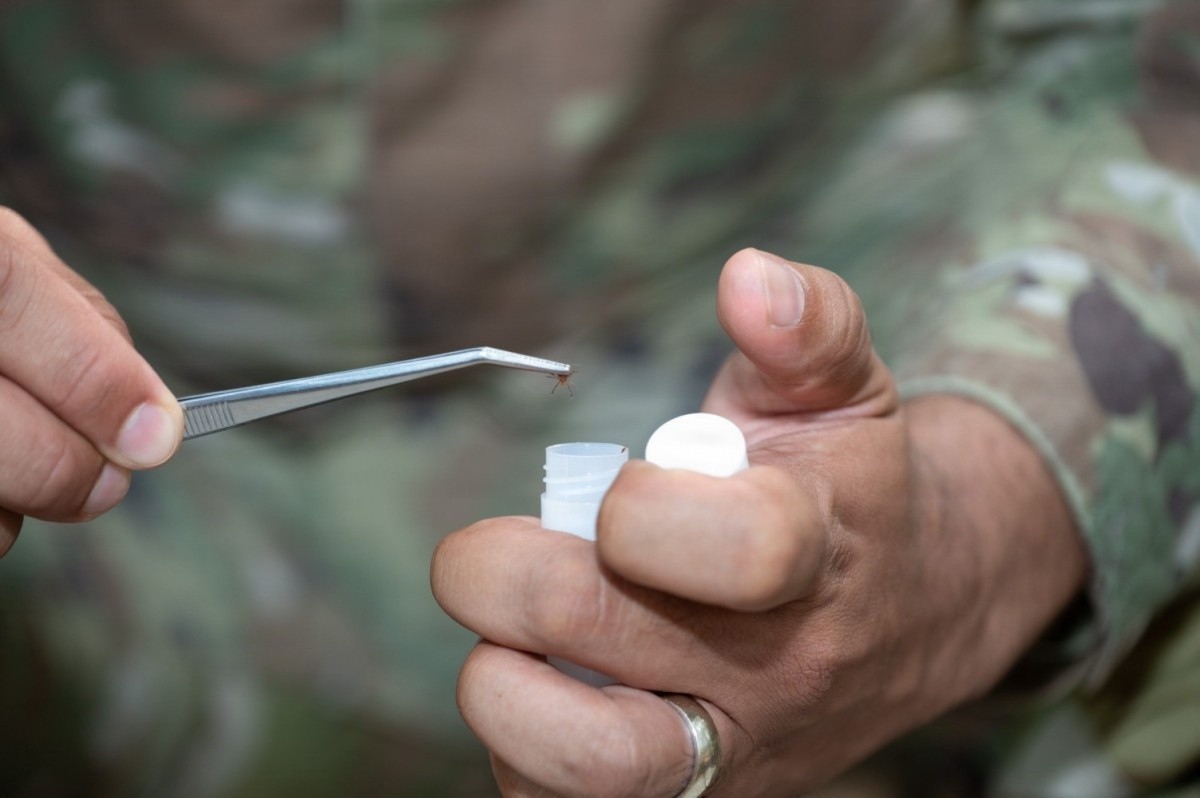
- Remove attached ticks immediately. It is rare for a tick to infect someone until it has been attached for more than four hours. Use fine-point tweezers to grasp the tick around its mouthparts, at the place of attachment next to the skin. Slowly pull the tick away from the skin until the tick is removed. Place the tick in a sealed container or small plastic bag and deposit it in the trash.
- Use tweezers or a tick removal tool. A study from Ohio State University suggests that commercial tick removal tools are very effective for removing adult ticks.
The Center for Disease Control recommends that after removing a tick, hands should be washed and the bite area should be thoroughly cleaned with rubbing alcohol, an iodine scrub or soap and water.
“You should remove any attached ticks immediately and go to Occupational Health where the tick will be sent to Aberdeen Proving Ground in Maryland for testing as part of the Defense Health Agency’s MilTICK program,” Powers said.
MilTICK is a free tick testing and identification service available for ticks removed from Department of War personnel and their dependents.
“Bring your tick to Occupational Health located in Bldg. 2222, fill out a submission form with basic personal contact information, and we will send the tick to Aberdeen for analysis,” said Maj. Eamon Graham, General Leonard Wood Community Hospital Environmental Health chief.
Ticks will be identified to species, assessed for how long they have been attached, and tested for human pathogens. The results will be reported back to the point of contact provided on the MilTICK form and will be used to assess the risk of tick-borne disease to military personnel.
Visit the MilTICK site for additional resources such as a tick identification guide and other useful tips on mitigating exposure to ticks.
-30-
About Fort Leonard Wood
Fort Leonard Wood is a thriving and prosperous installation that has evolved from a small basic training post more than 80 years ago to a premier Army Center of Excellence that trains nearly 80,000 military and civilians each year.
Fort Leonard Wood is home to the U.S Army Maneuver Support Center of Excellence and three U.S. Army schools: the U.S. Army Engineer School; U.S. Army Chemical, Biological, Radiological and Nuclear School; and the U.S. Army Military Police School. In addition to training engineer, CBRN and military police specialties for the Army, Fort Leonard Wood also provides gender-integrated in-processing and Basic Combat Training for new Soldiers.
Fort Leonard Wood also hosts and trains with the largest Marine Corps Detachment and Air Force Squadron on any Army installation as well as a large Navy construction detachment.